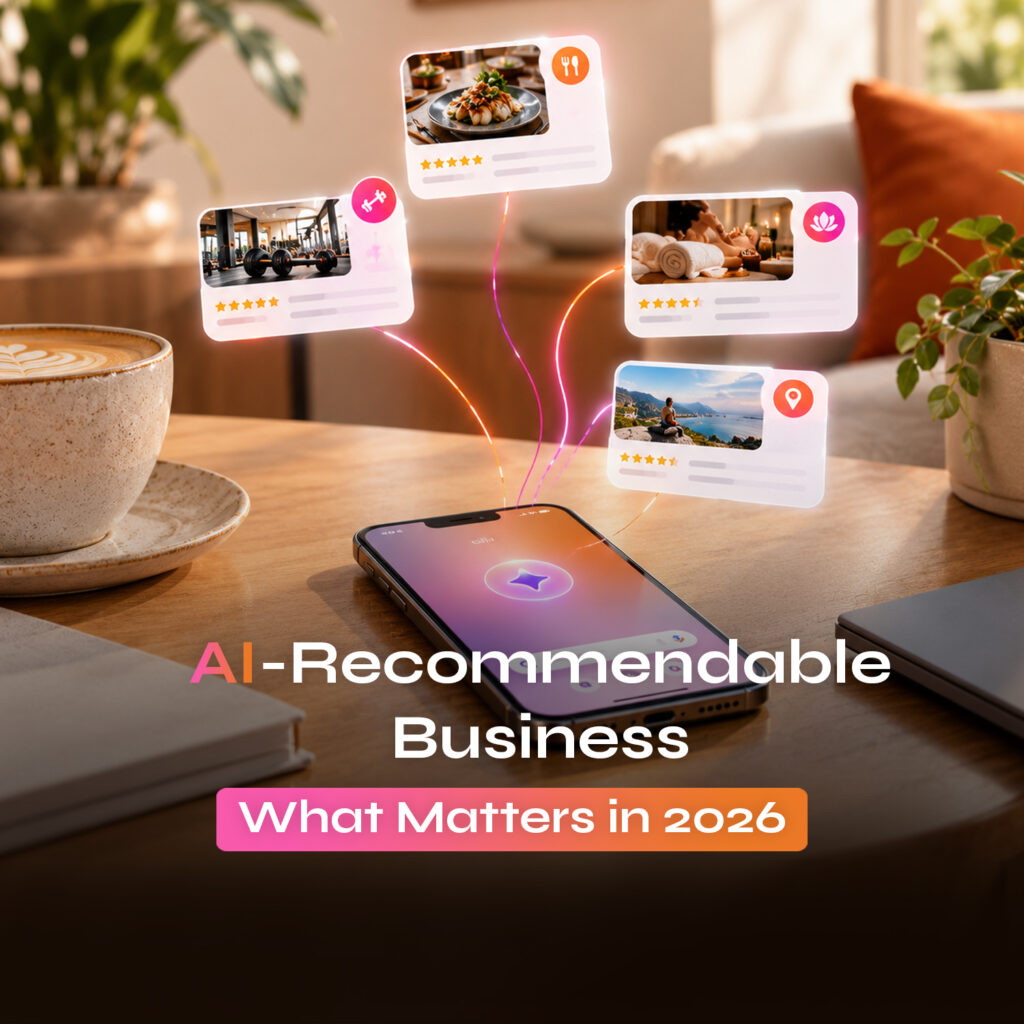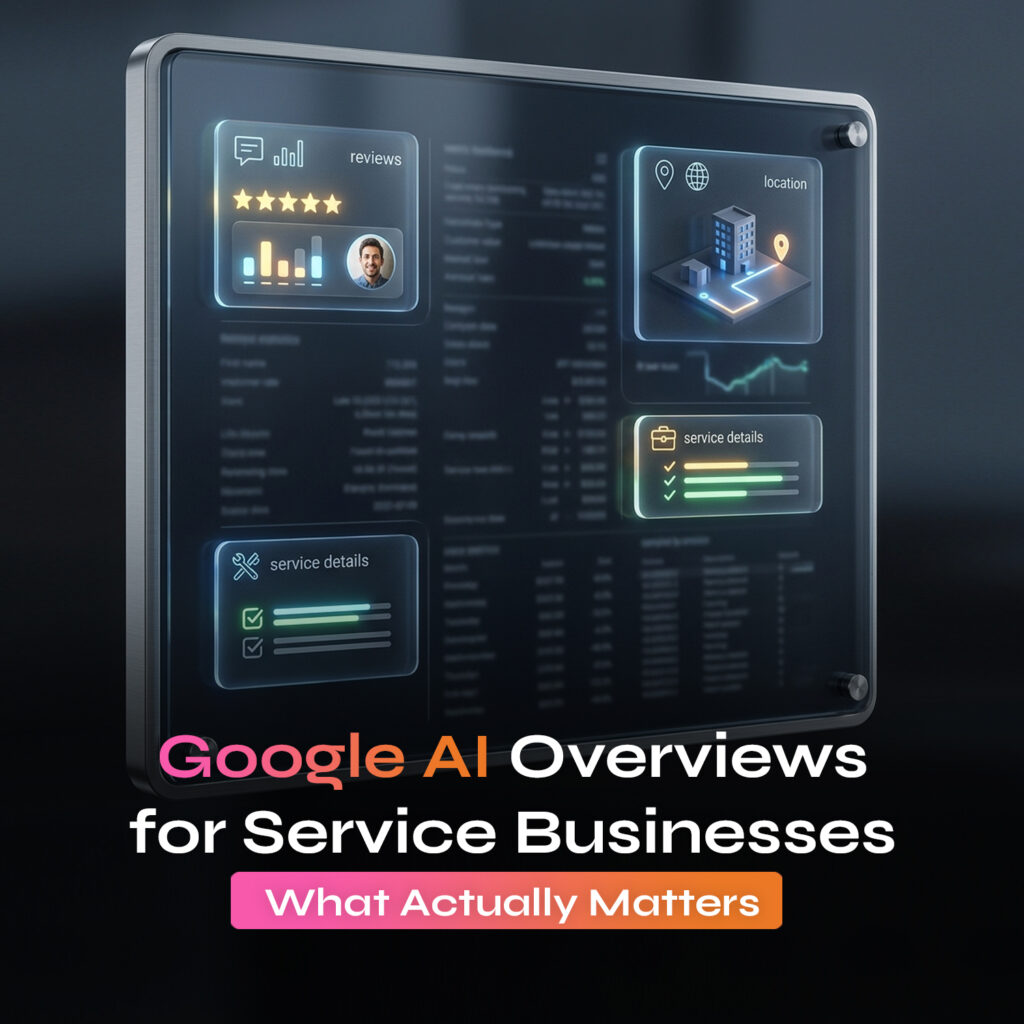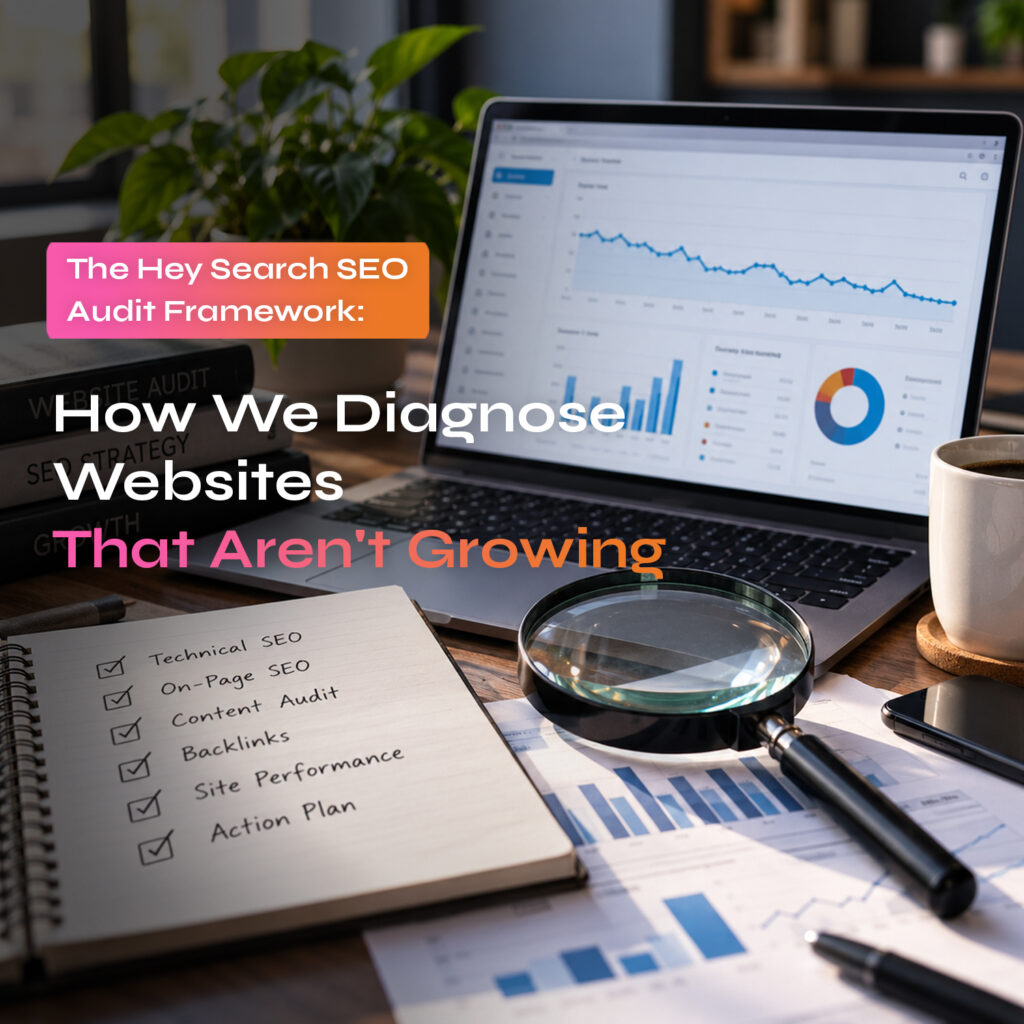
You searched for something in ChatGPT, Perplexity, or Google AI Overviews, and a competitor’s brand came up by name. Yours didn’t. That moment is not a coincidence, and it’s not luck. It’s the result of specific, identifiable signals that AI systems use to decide which brands are worth referencing.
This is the question every serious marketing leader in Dubai, Coimbatore, and across the GCC should be asking right now: why them and not us? The answer is surprisingly mechanical, and once you understand it, you can fix it.
This article breaks down exactly how AI systems decide which brands to cite, what the six core visibility factors are, and how to diagnose and close the gap, whether you’re based in the UAE, India, or anywhere globally.
What It Means to ‘Show Up’ in an AI Answer
There’s a meaningful difference between ranking on page one of Google and appearing inside an AI-generated answer. Traditional SEO gets users to click on your link. AI visibility means the AI system references, recommends, or describes your brand as part of its own response, with or without a direct link.
These AI answer surfaces include:
- Google AI Overviews the AI-generated summaries now appearing at the top of many Google searches
- ChatGPT (with browsing or web search enabled) makes direct brand recommendations in conversational responses
- Perplexity AI research-style answers with cited sources
- Gemini, Google’s AI assistant, is integrated across Search, Workspace, and mobile
When a potential client in Dubai asks ChatGPT ‘who is the best SEO agency in the UAE?’ and your agency comes up, that is earned AI visibility. When it doesn’t, you have an AI invisibility problem. The stakes are rising quickly.
How AI Answer Engines Actually Decide Which Brands to Reference
Most explanations of AEO (Answer Engine Optimization) treat AI systems like a slightly smarter version of Google. They’re not. Understanding the mechanics matters, because the fix depends on correctly identifying which layer of the system is blocking your visibility.
Training Data: The Foundation Layer
Large language models like GPT-4 and Gemini are trained on massive datasets scraped from the public web: news articles, Wikipedia, industry publications, blog posts, forums, and more. If your brand has been consistently written about, mentioned, and discussed across credible online sources before and during training cycles, you have a presence in the model’s learned knowledge.
If your brand exists only on your own website, with no meaningful third-party coverage, the model has little to work with. It either mentions a more-documented competitor or gives a generic answer.
Retrieval-Augmented Generation: The Real-Time Layer
Not all AI answers come purely from trained knowledge. Tools like Perplexity, Bing Copilot, and ChatGPT with web search enabled use a process called Retrieval-Augmented Generation (RAG). They search the live web in real time, retrieve relevant content, and use that to generate their answer.
This means your current, live content can influence AI answers, regardless of when a model was last trained. For businesses that don’t yet have deep training-data coverage, RAG is actually an opportunity: publish structured, authoritative, answer-ready content now, and retrieval-based AI systems can surface it today.
Entity Resolution: Does the AI Know Who You Are?
AI systems don’t just retrieve content; they resolve entities. An ‘entity’ in AI terms is a clearly defined, uniquely identifiable thing: a person, a company, a place, a product. When an AI system processes a question about ‘the best SEO agency in Dubai,’ it’s looking for entities it can confidently identify and trust.
If your brand name is ambiguous, inconsistently used across the web, or not connected to a structured knowledge graph entry (like a Google Knowledge Panel, Wikidata record, or Crunchbase profile), the AI may struggle to resolve your entity confidently and will default to brands it knows with certainty.
Entity clarity is one of the most underestimated factors in AI visibility. It’s the difference between the AI knowing exactly who Hey Search is, a Dubai-based digital marketing agency, versus treating it as an ambiguous search term.
The Six Factors That Determine AI Visibility for Your Brand
Based on how LLMs are trained and how retrieval-based AI systems select sources, six factors consistently separate brands that appear in AI answers from those that don’t.
1. Entity Clarity and Knowledge Graph Presence
Your brand needs to exist as a clearly defined entity online, not just as a domain name. This means having a verified Google Business Profile, a Google Knowledge Panel, a Wikidata or Wikipedia presence (if warranted), a Crunchbase profile, and consistent NAP (Name, Address, Phone) data across directories.
When these signals align, AI systems can resolve your entity with high confidence. When they conflict or are absent, the AI treats your brand as ambiguous, and ambiguity is invisible.
- Action: Audit your brand’s entity footprint across Google, Wikidata, Crunchbase, LinkedIn, and major directories
- Action: Ensure your brand name, address, and description are consistent everywhere
2. Brand Mentions Across Authoritative Sources
AI systems are trained on and retrieve from high-authority sources. News coverage, trade publications, respected blogs, academic citations, and industry roundups all act as signals that your brand is real, credible, and worth referencing.
Digital PR isn’t just about vanity metrics. A mention in a respected UAE business publication, a citation in an SEO industry blog, or a quote in a sector report can materially improve your AI visibility by embedding your brand into the authoritative web.
3. Structured Data and Schema Markup
Schema markup is code added to your website that helps both search engines and AI systems understand what your content is about. For AI visibility specifically, the most impactful schema types include:
Schema Type | Why It Matters for AI Visibility |
Organization schema | Defines who your brand is, what it does, and where it operates |
FAQPage schema | Structures Q&A content for direct AI extraction |
Person schema | Establishes founder/expert authority and entity clarity |
LocalBusiness schema | Critical for local AI answer visibility in Dubai, UAE, and India |
Article schema | Signals content authority and publication context to AI systems |
Brands without schema markup force AI systems to guess at context. Brands with schema markup give AI systems explicit, machine-readable answers, making extraction easy and citation more likely.
4. Content Quality and Answer-Readiness
AI systems prefer content that directly answers specific questions. This means well-structured articles with clear headings, concise paragraphs, question-based subheadings, and self-contained sections that can be extracted and cited independently.
Content that is vague, padded, or structured only for human reading, long narrative paragraphs with no clear discrete answers, is harder for AI to extract from and cite confidently. Answer-ready content is specific, accurate, and structured for machine comprehension as much as human comprehension.
- Action: Review your top service and blog pages. Can each section stand alone as an answer to a specific question?
- Action: Add FAQ sections to key pages, using actual questions your target audience asks
5. E-E-A-T Signals
Google codified the E-E-A-T framework (Experience, Expertise, Authoritativeness, Trustworthiness) for quality evaluators, but the same signals are critical for AI systems learning which sources to trust and reference.
Author credibility matters. If your content is attributed to a verified expert, someone with credentials, published works, industry recognition, and a consistent online presence, it carries more weight. This is one reason Dr. Fazulul Rahman’s published books, PhD credentials, and named case studies strengthen Hey Search’s AI visibility; the human expertise signal is clear and verifiable.
- Action: Ensure all key content has a named, credentialed author with a bio and linked profiles
- Action: Build your personal and business brand on LinkedIn, industry publications, and professional directories
6. Consistent Brand Signals Across Platforms
AI systems aggregate signals from multiple sources. If your brand presents differently across your website, LinkedIn, Google Business Profile, Crunchbase, and press coverage, with different descriptions, inconsistent naming, and conflicting service categories, it creates entity confusion.
Consistency is a trust signal. The brands that appear in AI answers most reliably are those whose identity, positioning, and factual details are coherent across dozens of online touchpoints. Think of it as writing a clear, consistent story about your brand that any AI can read and repeat accurately.
Why Your Competitor Shows Up, and You Don’t: A Diagnostic Framework
Before throwing budget at content or digital PR, run this diagnostic. It takes under an hour and tells you exactly where your AI visibility gap is.
Diagnostic Check | Invisible Brand | AI-Visible Brand |
Google Knowledge Panel | None or unverified | Verified, accurate, complete |
Third-party brand mentions | Mostly self-published only | News, trade press, directories, guest content |
Structured data on the website | None or partial | Organization, FAQ, Person, LocalBusiness schema |
Content answer-readiness | Narrative/padded pages | Structured, question-based, extractable sections |
Author credibility signals | Anonymous or minimal bios | Named experts, credentials, linked profiles |
Brand consistency across the web | Varying names/descriptions | Identical entity details everywhere |
If you score ‘invisible’ on three or more of these, that is your starting point, not more website content. Entity and authority signals come first.
What Businesses in Dubai and the UAE Should Know
AI answer visibility in the Dubai and UAE market has unique dynamics that generic global advice misses.
First, the competitive field is still relatively thin. Many UAE-based businesses have not yet invested in AEO or GEO, which means early movers gain a disproportionate advantage. Brands that establish entity clarity and structured content now will be the default references for AI systems serving the region.
Second, multilingual presence matters. AI systems serving UAE queries often process both English and Arabic content. Brands with structured, quality content in both languages and consistent entity signals across both have an advantage in dual-language queries.
Third, local authority publications are underused. Coverage in Gulf News, Arabian Business, Khaleej Times, or MEA-specific trade publications generates the kind of third-party validation that both trains AI models and appears in retrieval-based searches.
The AEO Action Plan: Where to Start
AI visibility is not a one-day project, but it is a systematic one. Here is the priority sequence used by the Hey Search team with clients building AEO visibility from scratch:
- Establish entity clarity first. Claim and verify your Google Business Profile. Set up a Wikidata entry if your brand qualifies. Align your brand name, description, and contact details across all platforms.
- Implement structured data on your website. Start with Organization schema, then LocalBusiness, then FAQPage on all relevant pages. Use a plugin like Rank Math or add it via your developer.
- Audit your content for answer-readiness. Identify your top five pages. Add FAQ sections, restructure walls of text into headed sections, and ensure each paragraph answers a discrete question.
- Build third-party authority. Execute a targeted digital PR campaign. Aim for 10–15 quality mentions in relevant publications within the first 90 days. Quality beats quantity.
- Strengthen E-E-A-T signals. Add author bios to all content. Link to credentials. Get the founder or key experts onto industry podcasts, speaking slots, or published lists.
- Monitor and iterate. Search your target queries regularly in ChatGPT, Perplexity, and Google AI Overviews. Track which competitors appear and study why. Reverse-engineer their entity and content footprint.
FAQ: AI Brand Visibility
What is AEO and how is it different from SEO?
AEO (Answer Engine Optimization) is the practice of optimizing your content and brand signals to appear in AI-generated answers, in tools like ChatGPT, Perplexity, Google AI Overviews, and Gemini. Traditional SEO targets ranked links in search results. AEO targets the AI-generated text that now often appears above those links, and inside standalone AI tools that users consult directly.
How do AI engines like Perplexity and ChatGPT choose which brands to cite?
Retrieval-based AI tools like Perplexity search the live web, select the most relevant and authoritative pages, and extract information from them. Selection is based on content relevance, source authority, content structure, and how clearly the content answers the query. Brands with structured, answer-ready content on credible websites are more likely to be retrieved and cited.
Does my Google ranking affect my AI answer visibility?
Partly. Google AI Overviews tend to draw from pages that already rank well for related queries, so strong organic rankings help. However, retrieval-based tools like Perplexity are not exclusively tied to Google rankings. A highly structured, credible page can be cited by Perplexity even if it ranks on page two of Google. Both signals matter, but AEO requires additional optimization beyond conventional SEO.
How long does it take to show up in AI answers?
For retrieval-based AI tools (Perplexity, ChatGPT with web search), well-optimized content can begin appearing within days to weeks. For training-data-based inclusion in LLMs, the timeline is longer, tied to model retraining cycles, which can range from months to over a year. This is why building a strong live web presence and structured content is critical: it captures retrieval-based visibility immediately while building toward long-term training-data inclusion.
Does structured data (schema markup) really help with AI visibility?
Yes, meaningfully. Schema markup gives AI systems machine-readable context about who you are, what you do, and what your content covers. FAQPage schema, in particular, directly formats your Q&A content in a way that AI extraction systems are designed to process. Brands without schema markup lose a significant interpretability advantage that structured data provides.
My business is well-known locally in Dubai. Why don’t I appear in AI answers?
Local recognition and AI visibility are not the same thing. If your brand’s web presence is limited to your own website, local word of mouth, and a few directory listings, with little third-party content, no structured data, and no knowledge graph presence, AI systems simply don’t have enough reliable signals to surface you. The fix is systematic, not a single change.
Can a small business in the UAE or India compete with bigger brands in AI answers?
Yes, especially on niche or local queries. AI systems don’t simply favor large brands; they favor clearly defined, well-documented, authoritative entities. A niche agency in Dubai or a specialist firm in Coimbatore that has built strong entity clarity, structured content, and relevant third-party mentions can outrank much larger brands on specific queries where they lack local or topical depth.
Conclusion
The brands showing up in AI answers didn’t get there by accident. They got there because they built the signals entity clarity, structured content, external authority, and consistent brand presence, which AI systems are specifically looking for when they decide who to reference.
Three things to take away from this article:
- AI visibility is mechanical, not mysterious. Once you understand the six factors, you can diagnose exactly where your gap is.
- Entity and authority signals come before content volume. Fix the foundation first.
- The window for early-mover advantage in Dubai, the UAE, and across the GCC is still open, but it won’t be for long.
The question is not whether AI answers will influence your business. They already do. The question is whether your brand is part of those answers or invisible inside them.