If your business is still asking whether SEO is “dead,” you are asking the wrong question. In 2026, the real shift is not SEO versus AI. It is how visibility now happens across three layers at once: traditional search rankings, direct answers, and AI-generated recommendations.
That is where the AEO vs GEO vs SEO debate comes from. The acronyms are useful, but they also create confusion. Teams start treating them like separate channels, separate budgets, or separate content strategies when, in reality, they overlap heavily.
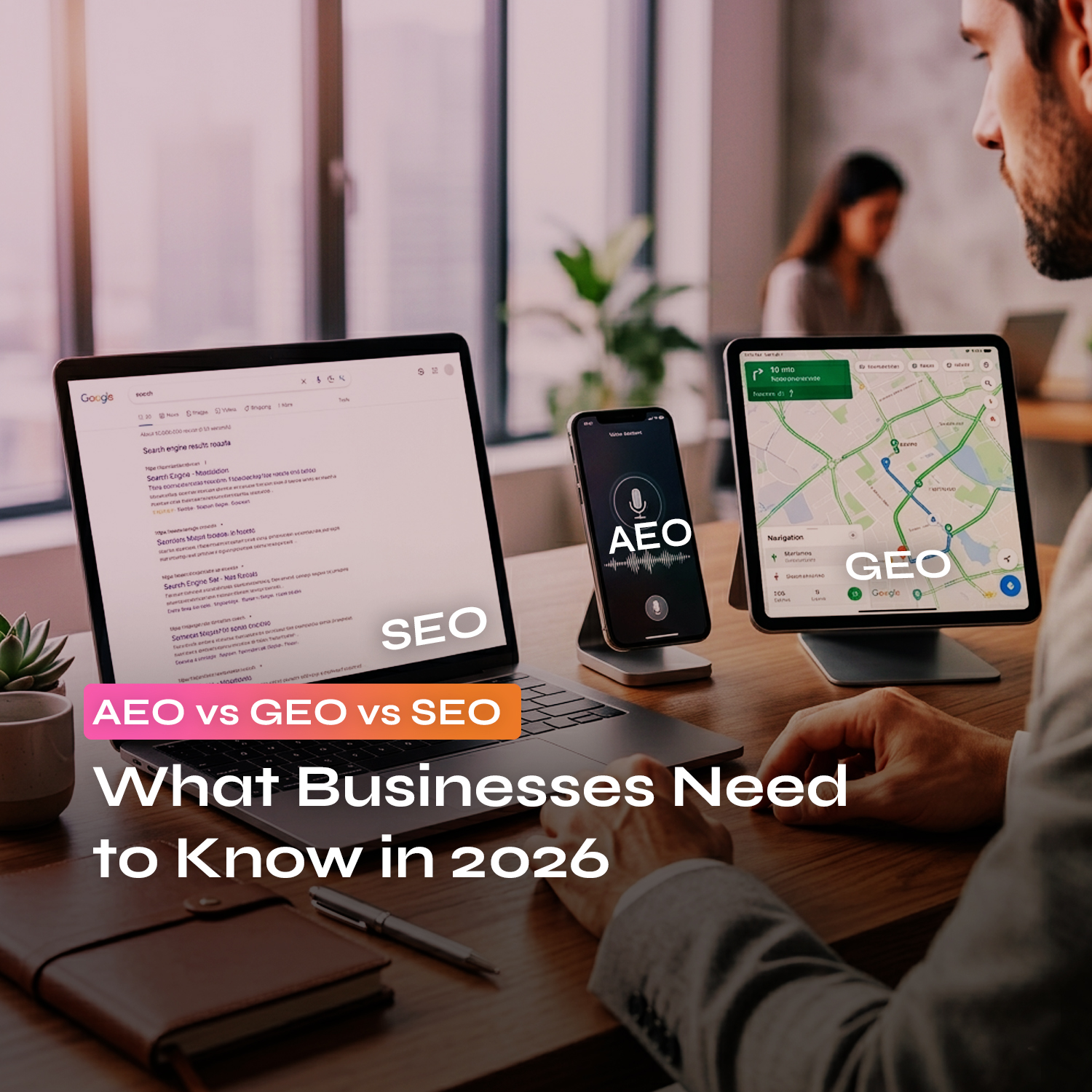
The practical answer is simple: SEO helps people discover you, AEO helps engines extract you, and GEO helps AI systems recommend or cite you. Businesses that understand that distinction make smarter decisions about content, technical SEO, brand authority, and measurement.
What do SEO, AEO, and GEO actually mean?
**SEO (search engine optimization)** is the discipline of improving your visibility in traditional search results. That includes rankings, organic clicks, topical authority, site architecture, crawlability, internal linking, page experience, and all the familiar work that helps Google and Bing understand and trust your pages.
**AEO (answer engine optimization)** focuses on making your information easy to extract and present as a direct answer. That can include featured snippets, AI Overviews, AI Mode responses, voice assistants, and other interfaces where users expect a concise answer instead of ten links.
**GEO (generative engine optimization)** focuses on how AI systems interpret, cite, and describe your brand or content in generated responses. It is less about ranking a page in position three and more about being included in the answer set when users ask a model or AI search interface for guidance, recommendations, or comparisons.
The easiest way to remember the difference is this: **SEO is about being found, AEO is about being quotable, and GEO is about being chosen.**
That distinction matters because not every business problem is the same. A publisher may care most about search traffic. A SaaS company may care about being named in “best tools” answers. A local clinic may care about showing up when someone asks an assistant for the best provider nearby.
AEO vs GEO vs SEO: the side-by-side comparison
Dimension | SEO | AEO | GEO |
Primary goal | Rank and earn clicks from search results | Get extracted as a direct answer | Get cited, mentioned, or recommended in AI responses |
Main surface | Google and Bing organic results | Featured snippets, AI answer layers, assistants | ChatGPT, Google AI features, Copilot, Perplexity, Gemini, and similar systems |
Core user action | Searches and chooses a result | Asks a question and gets an answer | Requests guidance, comparison, or recommendation |
Best content types | Service pages, category pages, landing pages, long-form guides | Definitions, FAQs, step-by-step pages, comparison blocks, concise summaries | Opinionated explainers, comparison content, original research, trusted brand pages, off-site mentions |
Key signals | Relevance, crawlability, links, page experience, topical depth | Clarity, structure, extractability, concise answers, schema where useful | Brand authority, entity consistency, cite-worthy content, freshness, off-site validation |
Typical KPI | Rankings, clicks, sessions, conversions | Snippet wins, AI visibility, answer inclusion | AI citations, mentions, recommendation presence, assisted demand |
Commercial implication | Drives site visits and direct pipeline | Shapes early understanding and captures direct-answer demand | Shapes preference before the click and increases shortlist inclusion |
This is why treating AEO vs GEO vs SEO like a winner-takes-all choice leads to bad strategy. They serve different moments in the same buyer journey.
Why do the acronyms create so much confusion
Part of the confusion is definitional. Some practitioners treat AEO and GEO as new names for old SEO principles. Others treat them as distinct disciplines. That disagreement exists because the underlying mechanics do overlap: strong information architecture, trusted sources, clear entities, and helpful content help everywhere.
There is also a platform problem. Google’s own guidance says the core SEO best practices still apply to AI features like AI Overviews and AI Mode, which pushes many marketers to conclude that AEO and GEO are just SEO wearing fresh clothes. That is directionally true at the foundation level, but incomplete at the strategy level.
The difference is not whether quality SEO still matters. It does. The difference is where visibility now happens and how performance is experienced by the user.
A ranking generates a click opportunity. An AI answer may satisfy the query before the click. A recommendation from an assistant may shape preference before the user ever visits your site.
So the smartest way to handle the acronym debate is to stop arguing over labels and start defining the job to be done.
What changed in 2026 and why this matters now
Search behavior is no longer limited to a classic ten-blue-links journey. Users can ask broader questions, chain follow-ups, upload images, refine intent conversationally, and receive synthesized answers with supporting links. That changes both discovery and attribution.
Google’s public guidance now frames AI features as an extension of Search rather than a separate SEO rulebook. At the same time, Microsoft has started rolling out AI visibility reporting in Bing Webmaster Tools, which is a strong signal that citations and AI presence are becoming measurable marketing assets rather than abstract theory.
This matters commercially because the old success model was simple: rank, earn clicks, convert. The new model is messier. A prospect may see your brand in an AI Overview, read a comparison in ChatGPT, ask Copilot to shortlist vendors, and only then search your brand directly.
That means businesses need to care about more than rankings. They need to care about retrievability, extractability, and recommendation quality across the buying journey.
Which should a business prioritize first?
For most companies, the right answer is not to start with GEO. It is to fix the foundation that makes SEO, AEO, and GEO all more likely to work.
Start with SEO first if your website has weak crawlability, thin service pages, poor internal linking, slow templates, scattered keyword targeting, or no real authority in your category. If the site is not strong enough to rank or earn trust, AI systems have little reason to surface it confidently.
Move into AEO next when you already have useful pages but they are hard to extract. This usually shows up when your content ranks decently yet fails to win featured snippets, AI citations, or answer-level visibility. The fix is often structural: cleaner headings, direct definitions, stronger summaries, better formatting, FAQs, comparison tables, and self-contained sections.
Lean harder into GEO when buying decisions increasingly happen in AI-assisted experiences. That is especially relevant for software, agencies, B2B services, healthcare research, travel planning, education, and other categories where users ask for recommendations, comparisons, and shortlist guidance.
In other words: SEO is the base layer, AEO is the formatting layer, and GEO is the market-perception layer.
A local business in Coimbatore does not need the same GEO investment as a global SaaS brand competing in AI-generated comparison prompts. But it still benefits from structured answers, strong location signals, and a credible digital footprint.
A Dubai-based company targeting high-value service buyers may need all three faster because its prospects are more likely to research across multiple surfaces before converting.
A practical framework: when to emphasize SEO, AEO, or GEO
Situation | Priority | Why |
Your site has weak rankings, weak internal links, and thin core pages | SEO | Fix the base before expecting AI systems to trust or surface the content consistently. |
You rank but rarely win snippets, summaries, or concise answer placements | AEO | Your problem is often structure, clarity, and extractability rather than raw visibility. |
Prospects ask AI tools for comparisons, recommendations, or shortlist advice | GEO | Your brand needs to be present in generated responses, not only in traditional SERPs. |
You are a local service business with inconsistent location authority | SEO + AEO | Local visibility and answer-ready pages usually deliver the fastest gains. |
You are a B2B or SaaS brand competing on category education and shortlist inclusion | SEO + AEO + GEO | Your buyers often move across search, AI summaries, and assistant-led evaluation before they convert. |
How to optimize for SEO, AEO, and GEO without building three separate strategies
The best 2026 strategy is not three separate teams with three separate content calendars. It is one integrated visibility model with different optimization lenses.
- Build pages that deserve to rank. Traditional SEO fundamentals still matter: clean site structure, strong page intent, internal links, original insight, technical health, and pages mapped to actual search demand. If your pages are weak, every higher-order tactic becomes harder.
- Make important pages answer-ready. Every core service, product, use case, and comparison page should answer the main question early, define terms clearly, and use scannable structure. Good AEO often looks like good editorial discipline: direct lead paragraphs, meaningful H2s, short blocks, tables, FAQs, and sharp summaries.
- Improve entity clarity. AI systems need to understand who you are, what you do, what markets you serve, and what claims are supported. That means consistent naming, strong about pages, author signals where relevant, clear service descriptions, and alignment across your site, profiles, and third-party mentions.
- Publish evidence, not just opinions. Original data, real examples, proprietary frameworks, expert commentary, and current explanations increase the odds that your content becomes cite-worthy rather than generic. Generic copy is easy for models to paraphrase and easy to ignore.
- Strengthen off-site authority. GEO is not only an on-page play. If the web barely mentions your brand, AI systems have less confidence in representing you. Digital PR, credible mentions, expert contributions, reviews, partner pages, and trusted citations all help shape recommendation likelihood.
- Keep strategic pages fresh. AI systems and search engines both prefer content that still reflects current reality. For 2026-sensitive topics, update examples, interfaces, terminology, and recommendations instead of letting strong pages go stale.
- Match format to intent. A definition page, a comparison page, a local landing page, and a thought-leadership article do different jobs. SEO, AEO, and GEO improve when the page format matches the prompt or query type it is trying to win.
- Design for extractability. Important claims should not be buried in fluff. Use clean summaries, decisive statements, concise bullets, and tables where comparison helps. A human reader should be able to skim and get the point. If that is hard, AI extraction will be harder too.
Key Takeaway: you do not need three strategies. You need one content and visibility system that is technically sound, editorially extractable, and trust-rich.
What this means for businesses in Dubai
Dubai markets are crowded, multilingual, and often high-intent. That increases the value of category authority, expert positioning, and comparison visibility. If you are competing in professional services, healthcare, education, real estate, or premium local services, ranking alone is not enough.
You need service pages that can rank, articles that can be extracted, and a brand footprint strong enough to be recommended when users ask AI tools for the best options, top agencies, or trusted providers.
For many Dubai businesses, the winning move is to connect strong local SEO with strong commercial content. A location page gets you discovered. A comparison guide helps you get extracted. Off-site authority and consistent proof help you get recommended.
What this means for businesses in Coimbatore
For many Coimbatore businesses, the opportunity is not to overcomplicate the model. Strong local SEO still does the heavy lifting: Google Business Profile optimization, local landing pages, review acquisition, service clarity, location signals, and pages that actually answer buyer questions.
AEO matters when your content explains services clearly enough to win answer-level visibility for informational and commercial queries. GEO matters more as competition matures and buyers begin using AI tools for provider discovery, comparisons, and shortlist building.
The practical priority is usually this: fix local SEO basics, improve answer structure on core pages, then build brand authority beyond your own website.
How should success be measured in 2026?
Measurement has to evolve because last-click organic traffic no longer tells the full story. A page may influence demand through an AI citation, branded search lift, or shortlist inclusion before a session ever appears in analytics.
Keep tracking classic SEO metrics like rankings, impressions, clicks, conversions, and assisted revenue. But add newer visibility signals where possible: featured snippet ownership, AI Overview presence, AI citation frequency, branded search growth, unlinked brand mentions, review velocity, and qualitative prompt testing.
The goal is not to abandon traffic metrics. It is to stop pretending traffic is the only meaningful outcome.
Common mistakes businesses make
The first mistake is assuming GEO replaces SEO. It does not. Weak pages and weak authority still undercut AI visibility.
The second mistake is publishing generic FAQ fluff and calling it AEO. Answer-ready content is not about stuffing question headings everywhere. It is about clear, useful, extractable information.
The third mistake is chasing AI mentions without building trust. If your brand has little authority on the open web, recommendation visibility will be inconsistent.
The fourth mistake is measuring only clicks. In 2026, influence often happens before the click.
Frequently asked questions
Is AEO replacing SEO?
No. AEO is expanding the visibility playbook, not replacing SEO. Search engines and AI features still rely on high-quality web content, so strong SEO remains the foundation.
Is GEO the same thing as AEO?
They overlap, but they are not identical. AEO is mostly about making information easy to return as an answer. GEO is broader and includes how AI systems interpret, mention, cite, and recommend your brand.
Can one page be optimized for SEO, AEO, and GEO at the same time?
Yes. In fact, the best pages usually are. A strong page can rank in organic search, provide a clean extractable answer, and become the kind of source AI systems are comfortable citing.
What matters more for local businesses in 2026?
Most local businesses should still prioritize local SEO first, then improve answer structure on core pages. GEO becomes more important as buyers start using AI tools to compare local providers and validate trust.
Do backlinks still matter if AI search grows?
Yes. Backlinks still matter because they remain a trust and authority signal in traditional search, and strong authority often supports broader visibility. They are just no longer the only signal that matters.
How do you measure GEO if analytics are messy?
Use a blended model. Track organic performance as usual, but add AI citation monitoring where available, branded search growth, mention tracking, review trends, and manual prompt testing for critical commercial queries.
Should every page have FAQ schema now?
No. Add FAQ content where it genuinely helps the user understand the topic. Artificially forcing FAQs onto every page usually creates clutter instead of clarity.
The AEO vs GEO vs SEO debate sounds bigger than it is. In practice, businesses do not need to choose one acronym and ignore the others. They need to understand what each one is responsible for.
SEO still earns discovery. AEO improves answer visibility. GEO improves how AI systems interpret and recommend your brand. That is the real 2026 model.
If your foundation is weak, start with SEO. If your content is hard to extract, improve AEO. If your market is increasingly shaped by AI-led discovery and recommendations, invest deeper in GEO. The strongest strategy is layered, commercially grounded, and tied to how your buyers actually research.
Book a free strategy consultation with Hey Search to map your SEO, AEO, and GEO priorities into one practical growth plan.