Most schools have a digital marketing problem that looks like a budget problem.
They spend on Facebook ads and get clicks that never convert. They post on Instagram and watch followers grow while inquiry forms sit empty. They rank for their own school name but appear nowhere when a parent types ‘best CBSE school in Dubai’ or ‘top engineering college in Coimbatore.’
The issue is not effort. It is not even a budget. It is that most educational institutions market without a framework; they choose channels based on what looks active, not on what actually fills seats.
This guide cuts through the noise. It maps every major digital marketing tactic to the actual enrollment decision journey, so admissions teams, school owners, and education marketers in Dubai, the UAE, and India know exactly where to invest and why.
The Enrollment Decision Has Moved Online
The prospective student or parent of 2025 does not walk into your school first. They search for you, compare you, read your reviews, watch your videos, and form an opinion all before picking up the phone.
Most prospective students begin their school research online [STAT: % of students who begin school search digitally verify source], often consulting Google, Instagram, YouTube, and review platforms before ever contacting an admissions office.
The journey is no longer linear. A parent might see a sponsored post, click through to your website, leave without inquiring, see your school mentioned in a WhatsApp group, Google you again a week later, read your Google reviews, and only then fill out a form.
Every gap in your digital presence is a leak in that journey. The schools winning on admissions are the ones who have plugged every leak, not just the ones who are most active on social media.
Why Most School Marketing Budgets Get Wasted
The most common mistake in education marketing is spending heavily at the wrong funnel stage.
Schools run brand-awareness campaigns when what they actually need is inquiry generation. They invest in social media content when they have no system to capture or follow up on leads. They drive traffic to websites that are slow, hard to navigate, and provide no clear next step.
The result: visible, but not converting.
The second most common mistake is measuring vanity metrics like likes, followers, and reach instead of actual admissions outcomes. These numbers feel like progress. They rarely correlate with enrollment.
The Admissions Funnel and Where Digital Marketing Fits In
Every enrollment follows the same basic path: awareness → consideration → decision → enrollment. Different digital channels perform differently at each stage. Mapping them correctly is what separates schools that convert from schools that just spend.
Funnel Stage | What the Prospect Is Doing | Best Digital Tactics |
Top of Funnel(Awareness) | Discovering options, not yet comparing | SEO blog content, Social media, YouTube, Google Display Ads |
Middle of Funnel(Consideration) | Researching, comparing, evaluating | Google Search Ads, Program pages, Reviews, Email nurturing |
Bottom of Funnel(Decision) | Ready to inquire or apply | Branded search, WhatsApp follow-up, Retargeting ads, Testimonials |
Top of Funnel: Awareness
At this stage, prospective students and parents are exploring options, not comparing institutions. Content that answers broad questions, curriculum comparisons, career outcomes, school life guides builds awareness and brings people into your funnel.
Middle of Funnel: Consideration
Now they are evaluating specific institutions. Your website’s program pages, admission process information, fee structures, faculty profiles, and Google reviews all matter here. This is where most institutions have the biggest gaps.
Bottom of Funnel: Decision
They have shortlisted you. What pushes them to inquiry? A specific prompt, a call to action, a WhatsApp conversation with your admissions team, a retargeted ad, a compelling testimonial. Speed of response is critical. Schools that follow up within an hour of an inquiry convert at significantly higher rates than those that wait 24 hours.
The Channels That Actually Drive Admissions
Not all digital channels perform equally for enrollment. Here is what the data and real-world education marketing tell us about each.
1. Local SEO – The Highest-ROI Channel Most Schools Ignore
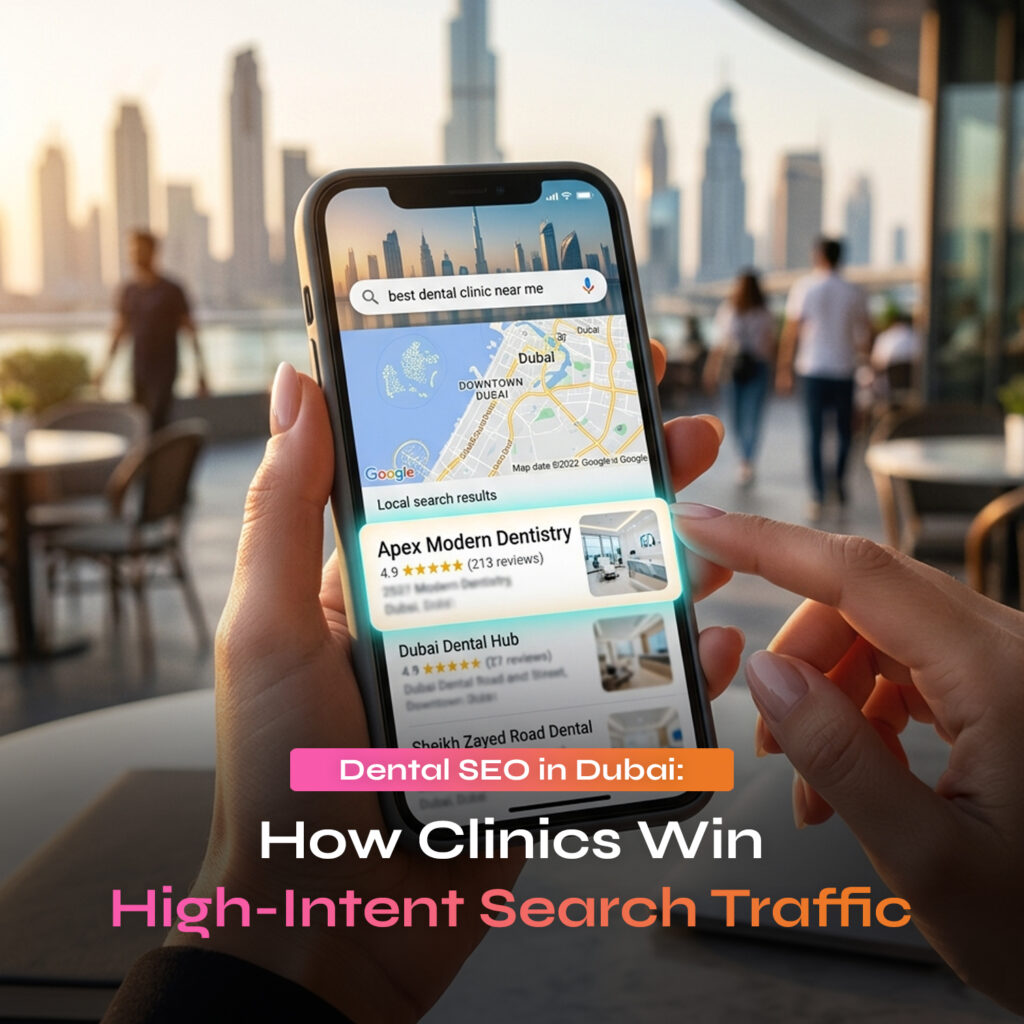
When a parent types “best international school in Dubai” or “top MBA college in Coimbatore,” local SEO determines whether your institution appears. This is the highest-converting entry point because the person is already searching with intent.
Local SEO for educational institutions involves three priorities:
- Google Business Profile optimization: Your listing must show accurate contact information, operating hours, photos, and consistent responses to reviews.
- Location-specific program pages: Each program or campus needs its own optimized page targeting relevant search queries.
- On-page SEO for admission-intent keywords pages should answer the questions prospective families are actually searching.
Schools that rank in Google’s top three local results receive the majority of organic inquiry traffic. Those that do not rank are essentially invisible to high-intent searchers. At Hey Search, our SEO services for educational institutions in Dubai focus on capturing this high-intent traffic before a competitor does.
Pro Tip Claim and fully complete your Google Business Profile. Schools with complete profiles (photos, Q&A, review responses, posts) rank higher and convert significantly better than those with skeletal listings. |
2. Google Search Ads – Capturing Students Who Are Ready to Inquire
Google Search Ads put your institution at the top of results for high-intent searches like “IGCSE school admissions Dubai” or “engineering admission 2025 Coimbatore.” These are people who are actively deciding, not just browsing.
For education marketing, Search Ads work best when:
- Campaigns target specific program keywords, not just the school name.
- Ads lead to dedicated landing pages, not the homepage.
- The landing page has one clear next step: book a campus tour, request a brochure, or call an admissions counselor.
- Conversion tracking is set up to measure actual inquiries, not just clicks.
Education sector Google Ads can be competitive, with CPCs varying significantly by location and program type [STAT: average education CPC in UAE/India verify source]. The key is targeting the right keywords with the right landing page; traffic alone means nothing if the page does not convert.
3. Meta Ads – Reaching Parents and Students Before They Search
Facebook and Instagram ads are top-of-funnel and mid-funnel tools that create awareness among people who fit your ideal student or parent profile before they begin actively searching.
In markets like Dubai and Coimbatore, parent demographics are highly targetable on Meta: nationality, income bracket, life stage, and interests can all be used to build an audience that mirrors the families you want to enroll.
Meta Ads for schools work best for:
- Promoting open house events and virtual tours.
- Retargeting website visitors who did not inquire.
- Lookalike audiences modeled on existing enrolled families.
- Time-sensitive campaigns around admission windows.
4. Social Media – Building Trust, Not Just Followers
Social media for educational institutions is not primarily a lead generation channel. It is a trust-building and consideration channel. When a parent has seen your institution on Google, they will check your Instagram or Facebook to get a feel for the campus culture, the teachers, and the community.
What actually builds trust on social media:
- Consistent faculty and student spotlights real people, real stories.
- Behind-the-scenes content: classrooms, labs, events, student achievements.
- Video tours of facilities especially important for international parents evaluating schools remotely.
- Transparent communication: fee structures, curriculum explanations, and admission requirements.
Engagement rate matters more than follower count. An institution with 3,000 engaged followers who comment, share, and ask questions has a stronger social proof signal than one with 30,000 silent followers.
5. WhatsApp and Email – Where Inquiries Actually Convert
Once a prospective family makes an inquiry, speed and quality of follow-up determine whether they enroll or go elsewhere. In the UAE and across India, WhatsApp has become the primary communication channel for education inquiries, far outperforming email for initial response rates.
An effective WhatsApp-based admissions system includes:
- A dedicated WhatsApp Business number is clearly displayed on every page of the website.
- Automated welcome messages with a brochure link and key program details.
- A human admissions counselor available to continue the conversation within one hour.
- A structured follow-up sequence, not just a single outreach attempt.
Email still works well for nurturing, particularly for post-inquiry sequences that share testimonials, admission deadlines, and event invitations. But email alone, without WhatsApp as the primary response channel, will cause you to lose prospects in the UAE and Indian markets before the conversation has even started.
6. Video – The Fastest Way to Build Emotional Connection
No medium builds institutional trust faster than video. A well-produced campus tour, a student testimonial, or a principal’s welcome message communicates what a thousand words of website copy cannot.
The investment does not need to be large. Short-form video on Instagram Reels and YouTube Shorts, combined with longer campus tour videos on YouTube, creates a content library that works 24/7, answering the questions prospective families have at every stage of their decision.
Research consistently shows that video content drives significantly higher engagement than static posts, and prospective students who watch a school’s video content are substantially more likely to complete an inquiry form [STAT: verify video engagement stat for education sector].
Priority videos to produce: campus tour, academic program explainer, student day-in-the-life, faculty introduction, admission process walkthrough.
7. Online Reviews and Reputation – The Silent Conversion Factor
Google reviews are one of the most underrated admissions drivers in education marketing. When a parent shortlists two schools with similar programs and fees, the one with better-reviewed, more recent Google ratings almost always wins the inquiry.
A proactive review strategy includes:
- Systematically requesting reviews from satisfied current families, typically after a positive interaction like an award, event, or report card.
- Responding to every review, positive and negative, professionally and quickly.
- Embedding reviews and testimonials prominently on admission landing pages.
- Monitoring and managing your reputation on third-party education platforms relevant to your market.
What Schools in Dubai and the UAE Need to Do Differently
The Dubai and broader UAE education market has characteristics that demand a different digital marketing approach from what works elsewhere.
The international family dynamic is the first key variable. In Dubai, the majority of families enrolling in private schools are expatriates, and many are evaluating schools from overseas before they relocate. Your website, your virtual tour, and your WhatsApp responsiveness need to serve a parent who cannot visit your campus before making an enrollment decision.
Arabic and multilingual SEO is an underexplored opportunity. While English is the primary language for many international school searches in Dubai, significant search volume exists in Arabic, Hindi, Malayalam, and Urdu. Institutions that optimize even basic landing pages in these languages can capture inquiry traffic that competitors are completely ignoring.
The admissions season in Dubai is distinctly timed, typically around October to February for the following academic year, with secondary peaks around April. Digital marketing campaigns need to be budget-weighted toward these windows, not spread evenly throughout the year.
Google My Business for multiple campuses requires careful management. UAE institutions often operate multiple campuses, and each needs a properly optimized, separately managed Google Business Profile. Consolidating all locations under one listing is a common mistake that depresses local search performance.
What Schools in Coimbatore and South India Need to Prioritize
In Coimbatore and broader Tamil Nadu, the education marketing landscape is intensely competitive, particularly for engineering colleges, polytechnics, and coaching institutes. Several factors shape what an effective digital marketing strategy looks like here.
Search behavior in Coimbatore is heavily mobile-first and often bilingual searches happen in English and Tamil. Institutions that optimize their program pages for Tamil-language searches and ensure their websites load fast on 4G mobile connections have a meaningful edge.
Parents and students in South India rely heavily on word-of-mouth and community validation, and in 2025, that validation happens across WhatsApp groups, YouTube review videos, and Google ratings. Engineering colleges and professional training institutes that actively seed their reputation in these channels see dramatically better inquiry volumes than those relying on offline marketing alone.
YouTube is particularly influential in this market. A well-optimized YouTube channel covering placement records, faculty introductions, student life, and exam prep content can drive qualified organic traffic at a cost no paid campaign can match over time.
Common Mistakes That Kill Admissions Campaigns
Across markets, the same patterns of underperformance appear repeatedly in education digital marketing:
- Sending paid traffic to the homepage. Every campaign should lead to a purpose-built landing page with one specific offer and one call to action.
- No lead follow-up system. Getting an inquiry is the start, not the end. Without a structured follow-up sequence via WhatsApp and email, most inquiries go cold within 48 hours.
- Inconsistent branding across channels. Different logos, phone numbers, and messaging across Google Business Profile, website, Facebook, and ads create trust friction.
- Prioritizing follower counts over conversion metrics. Follower growth feels like progress. Inquiry volume and enrollment conversion rate are the numbers that matter.
- No mobile optimization. If your website takes more than 3 seconds to load on mobile or requires users to pinch-to-zoom, you are losing the majority of your prospective families before they read a single word.
- Ignoring the parent channel in dual-audience markets. In Dubai and South India, the student is often the aspirant, but the parent is the decision-maker. Marketing that addresses only the student misses half the conversation.
How to Know If Your Digital Marketing Is Actually Working
The right metrics tell you whether your strategy is generating enrollment, not just activity.
Metric | What It Tells You | Target Benchmark |
Organic search traffic | Brand visibility and SEO health | Growing month-over-month |
Inquiry-to-enrollment conversion rate | Quality of leads and follow-up process | [STAT: benchmark verify source] |
Cost per inquiry (CPI) | Efficiency of paid campaigns | Lower over time as optimization improves |
Google review average and volume | Reputation and social proof strength | 4.0+ with consistent recent reviews |
Landing page conversion rate | Quality of page and offer alignment | [STAT: education sector benchmark] |
WhatsApp response rate | Admissions team responsiveness | Response within 60 minutes |
Any digital marketing agency or in-house team that cannot report on these metrics monthly is not managing your education marketing effectively. Activity is not accountability. Admissions outcomes are.
Frequently Asked Questions
What is the most effective digital marketing strategy for school admissions?
Local SEO and Google Search Ads are consistently the highest-ROI strategies because they capture intent at its peak, when a family is actively searching for an institution. These should be the foundation of any school’s digital strategy. Social media and WhatsApp follow-up amplify results once that foundation is in place.
How much should a school spend on digital marketing?
Budget ranges vary significantly by institution size and market. As a starting benchmark, many higher education institutions allocate several hundred dollars per enrolled student annually on marketing. For private schools and training institutes in Dubai, a focused monthly budget spanning SEO, Google Ads, and social media management should be evaluated against inquiry volume and enrollment conversion, not just reach metrics.
How long does it take for digital marketing to drive admissions results?
Paid advertising (Google Ads, Meta Ads) can generate inquiries within days. SEO is a longer-term investment; meaningful organic rankings typically build over three to six months with consistent effort. Reputation building through reviews is ongoing. A realistic full-funnel strategy should show measurable inquiry growth within 60 to 90 days.
Should schools target students or parents in digital marketing?
In most markets, particularly Dubai and South India, the answer is both, but with different content and different channels. Students respond to peer stories, campus life content, and career outcome data. Parents respond to academic standards, fee value, safety, faculty credentials, and institutional reputation. A segmented strategy that serves both audiences outperforms one that tries to speak to everyone with the same message.
Is social media marketing worth it for educational institutions?
Yes, but not primarily as a lead generation channel. Social media builds trust and validates your institution during the consideration phase. A prospective parent who has already found you through Google will check your Instagram before picking up the phone. A strong, consistent social presence shortens the time from discovery to inquiry.
How important are Google reviews for school admissions?
Very important and significantly underrated. Reviews serve as social proof at the exact moment a family is deciding whether to inquire. A school with a strong review profile consistently converts more of its search traffic into inquiries than one with few or negative reviews. Actively managing your review presence is one of the highest-ROI activities your admissions team can focus on.
What makes a digital marketing strategy for educational institutions in Dubai different from other markets?
The Dubai education market is international, multilingual, and heavily reliant on remote evaluation because many families are considering enrollment before relocating. This means your virtual tour, WhatsApp responsiveness, and English-language (and sometimes Arabic or Hindi) SEO need to be significantly stronger than what a typical school in a domestic market might prioritize. The competitive set is also global a Dubai family may be comparing your school against institutions in the UK, Australia, and Singapore simultaneously.
Conclusion: Marketing That Fills Classrooms, Not Just Feeds
Digital marketing for educational institutions is not about being everywhere at once. It is about being visible to the right family, at the right moment, with the right message, and having a system in place to convert that visibility into an enrolled student.
The highest-impact priorities for most institutions are the ones closest to the conversion point: local SEO, Google Search Ads, conversion-optimized program pages, WhatsApp follow-up, and an active review management strategy. Build those foundations before scaling social media spend or brand-awareness campaigns.
For schools in Dubai and the UAE, factor in the international family dynamic and multilingual search behavior. For institutions in Coimbatore and South India, prioritize mobile performance, YouTube authority, and Tamil-language digital presence.
Most importantly: measure what matters. Inquiry volume, inquiry-to-enrollment conversion, and cost per admission are the metrics that tell the truth about your marketing performance.